Adam, Noah, Moses and Jonah are important people in the Old Testament. But secular historians tell us there are reasons to doubt they ever existed, or at least doubt that the stories written about them are true.
On the other hand, Jesus speaks about three of these characters, apparently as if they were real people whose stories have been recorded in scripture. And Paul talks many times about the other character.
Does this prove they were real people and their stories are true after all?
Answering this question will open up some interesting and perhaps surprising information.
Introducing the characters

Adam (Genesis 1-3) was the first human being, created directly by God. He and his partner Eve were the progenitors of the entire human race, but also brought sin into God’s perfect world.

Noah (Genesis 6-9) built a wooden boat (the ark) and took on board two of every animal on earth, so they could survive with him and his family when God flooded the entire world.

Moses (Exodus, Leviticus, Numbers) confronted the Pharoah, obtained the release of two million Israelite slaves, and led them out of Egypt and across the Sinai to the borders of Canaan sometime about 1500-1200 BCE.

Jonah (c780 BCE) was a prophet who was thrown overboard from a ship, swallowed by a giant fish, survived and was thrown up on a beach – to make him obey God’s command to speak judgment to Assyria.
Each of these characters is mentioned in the New Testament:
- Adam is mentioned 8 times in the New Testament, mostly in Paul’s writings. Paul contrasts Adam as the first sinner with Jesus who takes away sin (e.g. 1 Corinthians 15:22).
- Noah is also referred to 8 times in the New Testament, mostly by Jesus, who refers to the story as if it was factual (e.g. Matthew 24:38).
- Moses‘ names appears a whopping 86 times in the New Testament. Mostly “Moses” is shorthand for “The Torah”, which came through Moses (e.g. Mark 1:44), but there is also the strange appearance of Moses and Elijah at the Trasnfiguration (e.g. Mark 9:4).
- Jesus refers to Jonah once or twice, reported in both Matthew and Luke, mostly referring to Jonah’s time inside the fish as a “sign”, just as his death and resurrection would be a sign (e.g. Matthew 12:40).
Historical evidence
Asking if these guys are real people is effectively asking if there is any evidence outside the Bible for them. So let’s see.
Adam
Human DNA and how it is passed down is evidence against there being a progenitor couple for the human race.
Each person receives half their DNA from each parent. (Mitochondrial and Y DNA are exceptions, but don’t affect the argument.) Mutations occur – on average, a child inherits about 60 mutations among the 3 billion DNA base pairs, So the genetic diversity in the world today comes from the diversity in the ancient human community plus the accumulation of mutations.
Geneticists have calculated that if there was a sole ancestral couple, to achieve today’s genetic diversity they would have had to live more than half a million years ago, long before homo sapiens appeared as a species. Most likely, today’s humans were descended from a population of several thousand living several hundred thousand years ago.
Unless God has tricked us by creating large amounts of new DNA as people were born, several aspects of the Adam and Eve story cannot be literally true. And since the story reads more like a folk tale or similar, with a talking snake (if it was a snake), a tree with magical powers, Adam naming all the animals (including polar bears and platypus?), and “Adam” meaning “man”, it seems reasonable to doubt that the Adam of Genesis was a real person.
Noah
It strains credulity to believe that (1) a flood could cover the entire world, (2) that every terrestrial animal and insect could have fitted on a man-made boat, and (3) that animals from the Arctic, Australia and elsewhere could have all travelled to and from the ark.
It’s also difficult to believe a loving God could have killed almost the entire human race in a violent cataclysm.
Stories of great floods are found in the folk takes of many cultures around the world, so there is nothing improbable about a family and their domestic animals surviving a large flood using a boat. And there’s no reason why this family couldn’t have been led by a man named Noah.
So Noah may have existed, but the Genesis flood story seems highly improbable.
Moses
Moses is one of the most important important characters in the Old Testament, so it’s not surprising there are many references to him in both Testaments. But little information elsewhere.
There are many reasons to doubt the Biblical story of Moses and the exodus.
- They are not mentioned in Egyptian history.
- The supposed dates don’t seem to work with dating of events in Egypt or Canaan.
- The numbers of people are way more than the archaeology shows could have settled in Canaan, and more than the total estimated population of Egypt at the time.
- The logistics of moving 2 million (or more) people across the desert seem impossible.
- There is no archaeological evidence of their 40 year presence in the area between Egypt and Canaan.
On the other hand, there is indirect evidence that a group of monotheistic Israelites did bring their religious beliefs to Canaan and began the formation of the Israelite people.
- The name “Moses” and the names of his brother Aaron and sister Miriam are probably Egyptian in origin.
- The design of the Israelite tent of meeting (more or less a portable temple) and the ark of the covenant (a sacred religious object kept in the tent of meeting) show Egyptian influence.
- It may not be a coincidence that Pharaoh Akhenaten, who lived a century or more before Moses, is often regarded as the world’s first monotheist, which may therefore have influenced Moses.
- DNA evidence shows that the Levites (Jewish priests who maintained Jewish monotheism) have different DNA to other Jews, whose DNA is similar to other people of Canaanite descent.
It therefore seems reasonable to conclude that the Levites came from Egypt and travelled to Canaan in the 13th century BCE, bringing monotheistic practices with them, which subsequently formed the basis of the Jewish religion. They must have had a leader, and he could easily have been named Moses. But other details of the story, especially the numbers, appear to be legendary.
Jonah
The story of Jonah is told in the small book of 4 chapters named after him. Jonah is mentioned once in 2 Kings 14:25, but is otherwise unknown.
The story seems historically improbable. Assyria was a brutal conqueror far and wide, and there is no sign of repentance (see e.g. Nahum 3) and a change in its actions around the time of Jonah.
Instead, it seems like a tall and humorous story about a real prophet, with unrealistic and exaggerated elements such as the size of Ninevah, ease with which an Israelite might travel 800-1000 km journey through hostile territory, the difficulty of preaching to the entire population and the response of the king.
But it seems Jonah was a real person, even if the whale story is doubtful.
Theology vs history & science?
So the best historical and scientific information suggests that most of the stories about these characters are exaggerations or legends, even if some of them were real people. But apparently Jesus and Paul spoke about them as if they were real?
Does this mean that we have to make a choice between believing Jesus and Paul or believing history and science?
Maybe not.
How first century Jews used their scriptures
We cannot assume that when first century Jews, including Jesus and the apostles, referred to their scriptures that they interpreted them in the same way we would. We mostly tend to try to quote references in context and in a logical systematic way. Exegesis (interpretation of what the text says) is taught in our Bible colleges, while eisegesis (reading our own meaning into the text) is frowned on.
So we need first of all to understand if first century Jews interpreted in the same way. And there a few surprises!
Many years ago now, I examined this question by checking out the accuracy of all Old Testament quotes in the first six books of the New Testament. I found that about half were interpreted accurately and in context more or less as we would today. But about half were interpreted less literally – quoted inaccurately, or taken out of context or with the meaning changed.
It turns out that this has been studied, and we can draw some clear conclusions about how first century Jews, including Jesus and the apostles, interpreted their scriptures (our Old Testament).
Eisegesis
They didn’t always try to use the exact meaning of the text, but often used the text in creative ways to support a view they already had. There are many examples of this:
- Out of context. In John 10:35-36, Jesus quotes Psalm 82:6 to support his claim to be the Son of God, when the original passage predicts the fall of false gods or kings posing as gods.
- Changing the meaning. In 1 Corinthians 15:55, Paul quotes Hosea 13:14, which has the prophet calling down destruction, whereas Paul uses the passage to talk about resurrection and the defeat of death.
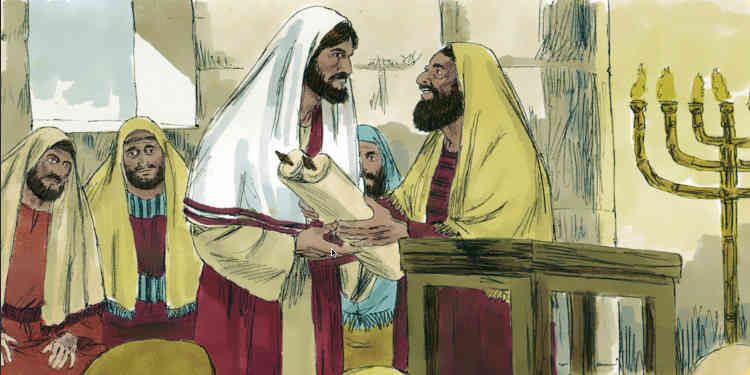
- Correcting or avoiding the meaning. In Luke 4:18-19 jesus quotes Isaiah 61:1-2 and 58:6, but omits a line about God’s vengeance. Paul also omits phrases promising God’s vengeance when he quotes Psalm 18:49 and Deuteronomy 32:43 in Romans 15:9 & 10. We can only conclude that they were trying to re-frame OT perceptions of a vengeful God as a loving God.
Change of wording = change of meaning.
- In Romans 11:26, Paul slightly misquotes Isaiah 59:20 – he says the deliverer will come from Zion, whereas Isaiah says the redeemer will come to Zion.
- When Paul quotes Psalm 68:18 in Ephesians 4:8, he changes the wording to mean the opposite of the original – from God accepting gifts from people to giving gifts to people.
These are only small changes in wording but they make a difference to the meaning.
Pointing to Jesus
The early Christians often took OT passages that had a particular meaning and applied them to Jesus, a process sometimes called “pesher”, meaning that the OT passage was now being interpreted in a new way. Examples include:
- Matthew 1:23 interprets Isaiah 7:14 as a prophecy of the virgin birth of Jesus. But in its original context, Isaiah was referring to a non-miraculous birth in the near future as a way of expressing the timing of God’s action to save his people from their enemies.
- Matthew 27:9-10 quotes Zechariah 11:12 about 30 pieces of silver, but changes the story into a prophecy of Judas’ betrayal.
- Psalm 118:22-23 refers to a stone in a gate, but in Mark 12:1011, Jesus says he is the stone that was rejected.
Not always literal
First century Jews sometimes interpreted their scriptures in allegorical or fanciful ways:
- In 1 Corinthians 10:1-4, Paul talks of a spiritual rock that accompanied the Israelites in the desert. Exodus 17 and Numbers 20 mention rocks that provided water for the Israelites at the beginning and end of their desert journey, but there is no suggestion the rock went with them. This is a later tradition in Jewish thought.
- In Galatians 4:21-31 Paul refers to the OT story of Hagar, Sarah & Abraham in Genesis 16, but allegorises it (he uses the word “figuratively”) to draw conclusions about the superiority of the new covenant over the old.
Not always historical
First century Jews and early Christians sometimes referenced people or events that weren’t in their scriptures, but in texts and stories that were less factual, and maybe legendary.
- 2 Timothy 3:8 refers to two men, Jannes and Jambres, who opposed Moses. You might expect these names to be recorded in the Torah, but no, they come from non-canonical Jewish writings that have little historical basis, and are dated to around the time of Jesus.
- Similarly, Jude 9 refers to a dispute between the archangel Michael and the devil over the body of Moses, and event not recorded in the Old Testament, and apparently found in an apocryphal first century Jewish text, The Assumption of Moses.
- Jude 14-15 quotes a prophecy by Enoch (an OT character 6 generations after Adam) that isn’t in the OT, but in the non-canonical book 1 Enoch.
More than one story
There are many places where the Old Testament tells different stories about events and teachings – e.g. Exodus 20:5-6 vs Ezekiel 18:4, Proverbs 26:4-5. It seems that the compilers of the Jewish scriptures valued seeing more than one way of viewing things.
John Walton says that the Torah should be seen as “instruction that gives wisdom” rather than legislation and law. Presenting different viewpoints promotes thoughtful reflection leading to wisdom.
Peter Enns says: “For Jews, the Bible is a problem to be solved. For Christians, it is a message to be proclaimed.” Perhaps it can be both for us?
Understanding all this
These and other examples show that Jesus, the apostles and other first century Jews, had a much more fluid view of their scriptures than modern westerners do. What they believed, what was authoritative and their principles of scriptural interpretation are complex and nuanced.
Here are some principles to help us understand this very different culture better.
What is scripture?
The contents of the recognised Jewish scriptures were developed in stages over maybe 500 years. It is generally believed that the Torah (the first 5 books) were recognised as authoritative by about 400 BCE, but the content of the other sections of the scriptures was still under discussion and being added to up to the time of Jesus. For example, the content and order of books in the Septuagint (a translation of the Jewish scriptures into Greek in the 3nd & 3rd centuries BCE) was different to that of the Hebrew scriptures.
The NT writers, and perhaps Jesus too, often used the Septuagint wording when they quoted the Jewish scriptures, meaning that the Christians didn’t have one authoritative text to work from..
In addition, many other writings had some level of authority or value despite not being included in the canon – e.g. the Apocrypha (books not considered divinely inspired but often considered of value), and the OT Pseudepigrapha (books written closer to the time of Jesus, often attributed to older historic figures and possibly reflecting long-standing traditions). Some of these books were quoted in the NT, as noted above.
This fluidity is in contrast to the greater certainty most Christians feel about their scriptures.
Don’t rush to modern interpretations?
Old Testament scholar John Walton points out that we must avoid making modern western assumptions about the OT text, and this would equally apply to understanding how the early Christians interpreted the OT. Here are a few of his guidelines:
- Honour the author’s intention. Don’t take words out of their context and opposite from the author’s intention.
- Recognise genre. Parable and apocalyptic are not historical narrative. A “literal” meaning may not be a correct reading.
- All the scriptures we read in English are translations, sometimes double translations, and every translation is an interpretation.
- Words that are roughly comparable in two languages often carry different nuances.
- Remember that the Bible, especially the OT, came out of an oral/hearing culture. The books we read are generally the end result of a long process of telling, re-telling, editing, etc.
Reality is bigger than history
To the ancients, the reality (which included God and the spirit world) was much bigger than mere history. Ancient authors, especially in the Bible, were not primarily interested in what we could film with a video camera if we were there. They were also interested in what the eye cannot see. They often saw God’s hand (or the hand of gods or other spiritual beings) in everyday events.
This meant they could use narrative forms to portray spiritual realities (as they saw them). If we mistake these narratives as being “historical”, we miss or distort the meaning of the authors. For example, ancient Jews saw God’s hand of help in victory and judgment in defeats on the battle field. And it might be that Matthew’s story (27:51-53) of the dead coming out of their graves when Jesus died was his way of portraying the importance of Jesus’ death. (It may not be of course, but we need to consider.)
Ancient literary conventions
Ancient authors therefore had literary conventions we need to understand:
- Narratives are not necessarily chronological. Authors would telescope events by compressing a long period of time into a few sentences. And the order of events may be theological rather than chronological. Or maybe placed in a pattern or framework that readers would recognise.
- Ancient authors would use figures of speech – metaphors and especially exaggeration. Words like “everyone ” and “all” may not be literal.
- Dialogue and speeches may not be verbatim, even if placed in inverted commas in our translations. We would say something like: “The king wasn’t worried about Isaiah’s prophecy” whereas ancient writers and historians would write “The king said: ‘The word of the Lord you have spoken is good'”.
In Jesus’ day, rabbis believed the scriptures were divinely inspired, and contained different levels of meaning which they had to unlock. So they used several different methods of scripture interpretation.
In addition to literal, “pesher” and allegorical interpretations already discussed, a generation before Jesus the influential rabbi Hillel had worked out seven “midrashic” interpretive principles. These were aimed at allowing exegesis that was deeper than literal, for example finding new meanings in passages by drawing on meanings of passages with similar words, even if the context was very different.
These principles allowed different interpretations of the same passage, including some that we would find quite fanciful. For example, Jesus’ argument in John 10:35-36 (discussed above), in Matthew 22:32 and elsewhere used some of these approaches in argument and discussion with rabbis and religious leaders.
The bottom line
It is clear that taking a modern western logical approach to understanding the New Testament will miss some of the subtleties of first century Jewish thought, as used by the rabbi Jesus and the Pharisee Paul.
So, did Jesus and Paul believe these OT characters were real?
It seems to me there are three possible answers to this question:
- They believed the stories which were literally and historically true.
- The stories were not actually literally & historically true, but Jesus and Paul never questioned the stories’ accuracy because they were part of first century Jewish culture.
- They didn’t necessarily believe the stories but used them because that would communicate with their hearers.
If we took a modern western approach to the scriptures, we would likely find it impossible to choose anything other than #1. But now we have seen how first century Jews interpreted scripture, all three are possible.
I feel confident that Paul was #2. It is quite believable (as we have seen) that the stories of Adam, Noah, Moses and Jonah are not fully historical but Paul didn’t know this back then.
And I feel it was the same for Jesus. After all, Philippians 2:7 says Jesus “emptied himself” or “made himself nothing” to come to earth and in Mark 13:32 Jesus says he doesn’t know the timing of God’s future plans. So it seems likely to me that Jesus didn’t know everything and part of the humility of his incarnation was that he thought like a first century Jew.
If so, then the historicity of these four characters and their stories must be determined by the evidence. In summary:
- Adam and Genesis 1-3 are legendary, but nevertheless teach us truths about God.
- There may have been a man named Noah, but the story of the ark and the great flood is legendary, probably based on a memory of a man who survived a local flood.
- Moses was probably a historical person who led a group of slaves out of Egypt and across the Sinai, but much of the exodus story is exaggerated or legendary.
- Jonah is almost certainly a historical character known as a prophet, but the story of his visit to Ninevah is an edifying tall story.
Does this mean we can’t be sure of anything?
It’s understandable that the information and ideas I’ve shared here might make you feel uncertain. How can we know if someone in the Bible is telling the truth or being fanciful?
But I don’t think we need worry.
- We’re not promised certainty, in our faith and in life generally. But we get by well enough (most of the time).
- Believing in a literal Bible doesn’t necessarily provide greater certainty – those believers still argue over many doctrines.
- The matters discussed in this post are part of the old covenant, which is now obsolete (Hebrews 8:13). We live in the glorious new covenant.
- Nothing I’ve outlined here stops the important things being true. There is still good evidence and reason to believe in a loving creator God, Jesus the dying & resurrected Messiah, forgiveness, the kingdom of God, the sermon on the mount, loving our neighbour, Christian fellowship and the indwelling Holy Spirit.
- We are meant to rely on the Holy Spirit as well as scripture (2 Corinthans 3:5-8, Romans 7:6).
Parting thought
I truly hope and pray that this information strengthens your faith in Jesus and answers questions, doubts and problems that may have been raised in your mind over Old Testament matters you have found difficult to accept.
Helpful books
- Biblical Exegesis in the Apostolic Period. Richard Longenecker
- Wisdom for Faithful Reading. John Walton.
- Inspiration and Incarnation. Peter Enns
- Disarming Scripture. Derek Flood.
- How the Bible Actually Works. Peter Enns.
Main graphic: Jesus is handed the scroll to read from Isaiah, and he chooses to omit the section about vengeance (Luke 4:18-19). All graphics from Free Bible Images.