There are many opinions about the Bible.
Some people believe it is the very words of God, totally accurate and reliable. Others think the Bible is close to a fairy tale and dangerously out of date.
Archaeology provides an objective measure to test the accuracy of the Biblical narratives. But it seems the Christian apologists and the sceptics both use it selectively to support their views of the Bible while ignoring things that don’t fit.
What if we allowed our understanding of the Bible to be informed by the archaeology?
Using archaeology to understand history
Most of our understanding of ancient history comes from documents and archaeology. Documents can outline what happened, but they come with the biases, assumptions and inaccuracies of their authors. Accounts of events may not be based on reliable eye witnesses. We may mistake a legend for history.
Archaeological artefacts are generally more objective – a coin is a coin and a building foundation is unmistakeable – but they require dating and intepretation before they can tell us much. And of course inscriptions can be used for propaganda just as a document can be.
So archaeology and history are best when they work together.
In the case of the Bible, archaeology can tell us when a city was destroyed, confirm the name of a king and give an indication (via artefacts) of the wealth and religion of a town’s inhabitants – all helpful in understanding the text.
Why we need experts
Interpreting archaeology and documents requires considerable knowledge and experience – understanding ancient languages and culture, geography and history. Also required will be specialist knowledge, e.g. of pottery, coins, architecture, clothing, agriculture, etc.
Most of us have little or none of this knowledge, so either we rely on the conclusions of the experts on factual matters, or our views will be based on ignorance of most of all this background.
Of course we don’t have to depend on experts for our belief or disbelief in Jesus, only the historical facts. Once we have those facts as best we can, we are free and responsible to decide our personal beliefs and commitments.
Confirmation bias
Confirmation bias occurs when we look for the answers we want to be true.
A believer may look for archaeological information that confirms their belief and try to find alternative explanations for facts which throw doubt on their beliefs. A sceptic can do the same.
If we truly want to know the truth, we will consider all the evidence, consider the views of both sides of the question, and rely most on the most objective experts. Of course none of us can do this perfectly, but we can honestly try.
The Bible and archaeology
In Archaeology and the Bible, I have examined in detail what the experts say about Old and New Testament archaeology. I have read what the minimalists (sceptics) and maximalists (believers) say, but have tried to avoid confirmation bias by taking most notice of the mainstream of archaeologists.
The conclusions are reasonably clear:
The patriarchs up until the time of Joseph (Genesis)
Not much Biblical archaeology remains from this period (Early to Middle Bronze Age – around 2100 BCE to 1600 BCE). The patriarchs were nomadic peoples, and so would have left few, if any, artefacts behind.
These Biblical stories were probably passed down, adapted and embellished, for more than a millennia before being written down. Yet they still reflect the nomadic, kin-based, multigenerational, polygamous culture of that time, and some names and practices fit texts & tablets written at that time. This suggests to many historians that there was some historical truth to the names or the stories, though likely a lot of legendary embellishment.
Conclusion: archaeology neither confirms nor disproves these Old Testament accounts.
The exodus from Egypt and settlement in Canaan (Genesis to Judges)
Like the earlier period, there is little archaeological evidence of the Exodus from Egypt. Archaeologists wouldn’t expect much, but the lack of evidence may be significant. Some indirect evidence shows that it is quite feasible that a group to travelled from Egypt to Canaan around that time, and perhaps they formed the Levites (Jewish priests). But the size of towns and the amount of development and agriculture in Canaan indicates a population of about 60,000, so the number of Israelites could not have been anywhere near the two million claimed by the Bible.
There is a lot of archaeological information for the supposed conquest of Canaan and settlement by the invading Israelites. It tends to show that many of the Biblical accounts are exaggerated or legendary, though with some factual basis. Of 31 cities Joshua 1-12 says were conquered at this time, only a handful show any evidence of that, and most of those locations that can be identified were not destroyed then.
Joshua 13-24 describes a much slower and incomplete occupation of Canaan by the Israelites, and this appears to be closer to the archaeological evidence.
Conclusion: It is virtually certain that a large group of Israelites did not conquer Canaan as described in the Bible, but a smaller group did probably bring some new ideas that led to the development of the Jewish religion and nation.
The time of the monarchy (1 Samuel onwards)
Many ancient sites from this period have been excavated and the archaeological information generally confirms the historical narratives in the Bible. The Biblical accounts of Assyrian invasion, warfare with Moab, the Babylonian invasion, the fortification of several cities and a number of names of Kings, have all been generally confirmed by archaeological finds, although other nations give different explanations of the same facts found in the Bible – illustrating how history is told differently by winners and losers.
The reigns of Saul, David and Solomon are not so clearly supported by the evidence, but David’s name is mentioned and there isn’t anything much to contradict the Biblical accounts. Of course archaeology cannot confirm (or otherwise) the involvement of God in the story of the Jewish people.
Conclusion: It is clear that the Biblical accounts give a reasonable outline of the history of this period. The stories are presented in a way that makes a national and theological point, but this is common in ancient history and these perspectives have to be accounted for in all historical analysis.
New Testament
Jesus didn’t leave behind any books, his head doesn’t appear on any coins and there were (as far as we know) no inscriptions about him. But the archaeological information generally shows that the authors of the gospels and Acts wrote accurately about culture, locations and people.
Some locations were destroyed or changed in the decades after Jesus’ death, yet John’s Gospel written much later correctly, albeit briefly, describes these locations. Likewise Luke (in Acts) generally gets names and titles right.
Conclusion: The archaeology doesn’t tell us everything we’d like to know, but it broadly supports the New Testament accounts.
What all this tells us about the Bible
A Christian who believes the Bible is without factual error may resist the idea that archaeology shows that some parts of the Old Testament are not accurate history.
But instead of thinking these conclusions are a threat to our faith in the Bible as history, this information can help us gain a better understanding of the Bible God has given us.
Instead of fighting the evidence, we can run with it and see where it leads.
Different genres of literature
The Bible contains many different genres of literature – history, biography, poetry, letters, proverbs, apocalyptic, parables, laws, and so on. Each genre expresses information and ideas in different ways and for different purposes.
For example, Jesus told parables – fictional stories that illustrate an idea – presumably because he believed this was the most effective and memorable way to make his points. It is easy to remember his stories of the Good Samaritan or the Prodigal son.
Another example is the book of Proverbs in the Old Testament, which contains proverbial sayings and wisdom. Some proverbs contradict others, but the purpose isn’t to give strict rules of behaviour, but rather to give thoughts to chew on.
Apocalyptic is another example. Parts of the books of Daniel and Revelation use apocalyptic imagery which cannot be taken literally (e.g. Jesus in Revelation is pictured as a man in white with a sword coming out of his mouth, a lion and a lamb with seven horns), but rather paints a dramatic and symbolic picture. It makes no sense to try to read it like a desription of actual events.
So, could God use other genres?
Is there any reason to assume that God couldn’t use other genres of literature, such as saga or legend? Could stories like Noah’s ark or the sun standing still be legendary but still tell us something?
Could the Bible be a record of growth towards truth?
Jesus made it clear that he was superseding some Old Testament commands, or taking them to a new level (see for example, Matthew 5:22, 28, 32, 34, 39). The writer to the Hebrews said the Old Testament covenant was now “obsolete and outdated” (Hebrews 8:13).
So rather than the Old Testament being God’s immutable laws and accurate history, could it be a record of what the Jewish people believed about God as he took them on a journey from primitive belief in a tribal God to the loving God of Jesus, from barbaric ethics to the Sermon on the Mount?
As CS Lewis wrote (my emphasis):
“If you take the Bible as a whole, you see a process in which something which, in its earliest levels …. was hardly moral at all, and was in some ways not unlike the Pagan religions, is gradually purged and enlightened till it becomes the religion of the great prophets and Our Lord Himself. That whole process is the greatest revelation of God’s true nature. At first hardly anything comes through but mere power. Then (v. important) the truth that He is One and there is no other God. Then justice, then mercy, love, wisdom.”
Jesus remains the same
None of this changes what we know and can believe about Jesus. The gospels stand as biographies of Jesus. Jesus is still the son of God, the Messiah who fulfilled the Old Testament prophecies in ways most of his contemporaries struggled to recognise, because he fulfilled them in creative ways.
This is the Bible God has given us ….
Let’s embrace it, not fight it.
…. and it makes some things easier
Why spend our time trying to defend stories that are frankly unbelievable. (Were there koalas and platypus on Noah’s ark?)
Why try to defend the morality of God’s command to commit bloody genocide, when all the evidence suggests (i) it never happened, and (ii) God didn’t command it, the Israelites just put those words in his mouth.
Instead of impugning God’s character, let’s re-adjust our understanding of scripture.
If we let go of a faulty view of scripture, instead of defending inerrancy, we can better spend our time loving God, loving our neighbour and making disciples by pointing people to Jesus.
Archaeology can help us see God and scripture better.
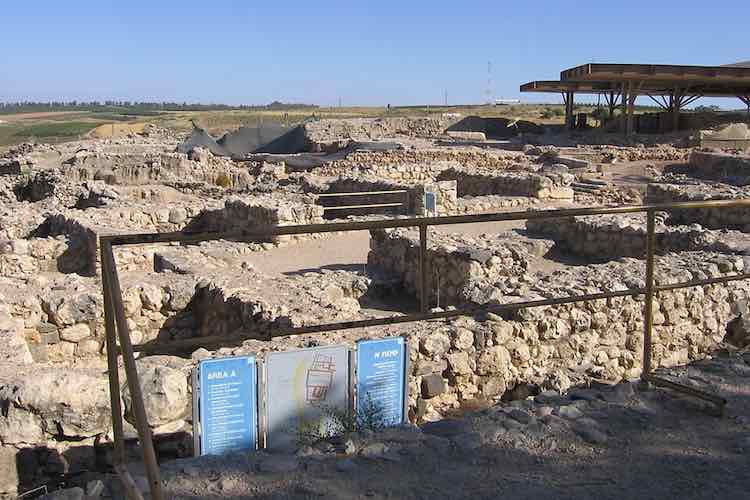
Main photo: The Chambered Gate of Hazor in the upper Galilee, Israel (Wikimedia Commons).



Very objective, and therefore far more convincing than the Bible “literalists”.
Well done!
Thank you! Nice to hear from you again!
Maybe some far out Bible stories could have a basis in fact.
I think it’s quite possible that there was a person called Noah, or something similar who was sick of getting flooded out and built a boat to carry his family and a few breeding stock to higher ground, and the story got passed down and embellished over the years to the point of the “2 of every species” mantra that we now have.
The parting of the Red Sea could have been caused by certain winds and then got adopted as “God’s will”.
Much easier to fool people when there was no science available.
I agree. As I say in the post, maximalists tend to accept most everything, minimalists tend to accept very little. But my view, and I think the majority view, is as you say – some historical-factual basis with legendary elements added on over the years. Of course it still remains uncertain how much of each.
But there are flood stories in many middle eastern cultures (and elsewhere around the world), and flood events obviously happen, so it isn’t hard to imagine a true story that grew in the telling.