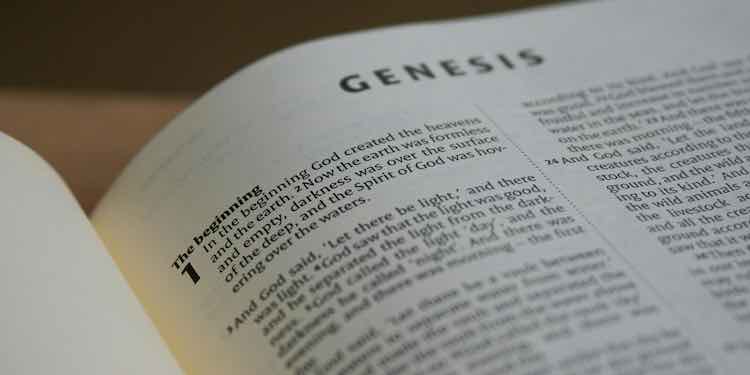
Charles Darwin wrote about the concepts of biological evolution and natural selection 166 years ago. Since that time, many Christians have opposed evolution because it so clearly presents a very different picture to that portrayed in the book of Genesis.
But it seems that, more and more, Christians are happy to accept the science and make adjustments to how they understand Genesis, and indeed the whole Bible.
So if we accept evolution as true, what difference does it make to how we read the Bible?
Why think evolution is true?
Despite some Christians’ misgivings, there are good reasons to accept that evolution is a generally correct description of how human life was formed. (For a more detailed outline, see Genesis vs evolution.)
- The fossil record, together with radiometric dating, provides a reasonable though not complete picture of the evolution of life.
- Similar anatomical or cellular structures in different animals support the idea of common descent.
- The reality of natural selection has been shown in modern experiments and observations of how populations adjust to changing environments, as predicted by natural selection.
- Most convincing to me is the use of DNA to show genetic similarities and identify common ancestors. This has been shown to be reliable in family history research, and uses the same principles to develop the human “family tree” and show the evolutionary path and timescale that led to us.
It is fair to say that if evolution isn’t true, the God has made it look as if it is true.
Of course very little in science is certain and finalised and there are still unresolved questions – the toughest challenge to evolution remains explaining the origin of life. But the other common doubts raised against evolution (gaps in the fossil record, the Cambrian explosion, transitional processes and irreducible complexity) don’t, it seems to me, threaten the basic facts of evolution. (Read more about the supposed difficulties.)
“Problems” for Christian theology
If evolution is true, some Christian doctrines need to be competely reconsidered.
- Adam & Eve: DNA evidence indicates that the human race couldn’t have descended from a single couple, unless God artificially created an enormous amount of DNA variability.
- The fall: how could there be a “fall” (one act = eating fruit from a certain tree) which brought death and pain into the world if there had been animal predation and death for millions of years?
- Original sin: if there wasn’t a single couple “falling” into sin, then how could the rest of the human race be affected?
- New Testament references: the New Testament several times refers to Adam and Eve as if they were literal historical people.
Resolving these difficulties requires we review how we understand the Old Testament.
A better understanding of the Old Testament
It is natural and easy to simply read the Old Testament as if it was a modern “western” document – take everything at face value and try to find explanations for inconsistencies and anomalies. But there are good reasons what this is inadequate. (Much of the ideas in this section come from respected Old Testament scholar John Walton. Not all agree with Walton, but most reviews endorse much of what he says, at least.)
1. Anomalies, inconsistencies & violence
It isn’t hard to find teachings and events in the Old Testament that challenge the view that it is an inerrant text by a loving God.
There are many examples of inconsistencies and contradictions, where one author differs from another. Instead of trying to find explanations for every last one of these to preserve our doctrine of inerrancy, it seems more honest and more accurate to say that different authors had different purposes and perspectives, and so as human beings gave different information that wasn’t always consistent.
And while God is mostly depicted in the Old Testament as being loving and merciful, there are many examples of his commands and threats which seem anything but loving. It is obvious that mere humans can’t fully understand the ways of God, but commands for brutal genocide can hardly be considered “loving” on any understanding. Again, it seems better to affirm the loving nature of God and doubt the historical accuracy of these violent depictions, than to preserve inerrancy while impugning God’s character.
So however we see God’s inspiration of the Old Testament, we must allow for human idiosyncrasies and error in an unfolding revelation that shows how God gradually led his people out of tribal polytheism into ethical monotheism.
2. Ancient culture vs modern culture
It shouldn’t be a surprise to understand that ancient people thought differently to modern people. They acted and wrote down their stories from within their own culture. And as I outline below, some of the differences between their thinking and ours significantly affect how we should understand the scriptures.
Had God miraculously enabled them to write according to the pattern of our culture, no-one back then could have understood them, and it is doubtful that the stories would have been handed down nor the documents preserved.
So to properly understand the scriptures, we need to understand how an ancient Semite thought rather than think like a postmodern Anglo.
(I recognise that not everyone can know how to do that. But (i) the core truths of Christian faith are available to anyone who can read, and (ii) in this day of expanding human knowledge, when we need to have a deeper understanding, the information is available to us.)
3. Genre
It is obvious that genre is important to understanding.
This is true in everyday life. We understand that fantasy fiction, stand-up comedy, satire and children’s stories will not carry the same level of literal objective truth as a scientific paper or a legal judgment.
Similarly, we don’t interpret the book of Revelation, the Song of Solomon or the parable of the Rich man and Lazarus the same as we would interpret Mark’s account of Jesus’ crucifixion.
As we shall see, understanding the genre of Genesis will affect how we intepret it.
4. Authors’ intentions
Each author has their own literary, linguistic and cultural background. Each may use rhetorical devices (metaphor, exaggeration, allegory, figurative speech, etc) to get their message across. To understand the author, we need to try to understand their rhetorical devices and what they were intending to communicate.
For example, Old Testament literature uses devices such as telescoping (compressing a long period of time so it appears in the text to be short), exaggeration (the accounts of battles typically overstate the extent of the victory) and attributing speech (putting into the mouths of characters words that they may not have actually said, but which illustrate their attitudes). It would be a mistake to assume these devices were all intended to portray literal truth. For example, Jesus is neither a literal lion or lamb even though he is portrayed that way in Revelation.
So we need to try to understand genre, literary conventions, use of words, context and purpose. We must be aware that word meanings change, and translations cannot perfectly represent what an author originally said. For example, the English word “deceive” is used to translate eleven different Hebrew words, each of which carries a slightly different meaning.
5. “History” isn’t history
If we read a history book, we reasonably expect the author to give us a factual and unbiased presentation of what is known. If we think a little deeper, we recognise that everyone has their own perspective (which may amount to a bias), but we expect the historian to not allow that perpective to colour their discussion too much. (Whether we get what we expect is sometimes a matter of debate!)
But ancient writers didn’t think in this way. For the Hebrew story-tellers, the objective facts (as we would see them) weren’t always the primary thing. The supernatural world was just as real to them as the physical world, and the supernatual machinations behind the visible events were often more important to them than the events themselves.
So generally stories weren’t told just for the sake of narrating past events, but to teach theology, to explain Israel’s place in the world, to make a case for Israel’s right to the land they occupied or some other purpose. So the narration of a victory in battle might aim to show that Israel’s God was more powerful than the gods of neighbouring tribes. An account of God’s punishment might help explain why the Israelites lost a battle or were invaded. These motives might be present whether the account is historical, legendary or a mixture of both.
6. Seeking wisdom
Many Christians believe that the Bible gives us precise rules for what we should believe and how we should behave. Some doctrinal statements or creeds reinforce this view.
The word “Torah”, the first five books of the Old Testament, is often translated as “Law”, but it is better translated as “instruction”. So it should properly be understood not as fixed Law to be obeyed at all costs, but instruction that leads towards wisdom. Statutory law was foreign to ancient thinking – their law was much more based on the wisdom passed down by the community.
This understanding is revolutionary! It means instead of blindly applying the Old Testament laws to our lives today, we should consider questions like:
- If these are actually laws from God, should they be applied everywhere and at all times?
- Some laws are strange, irrelevant or even repulsive today. Should they be applied today?
- If not fixed laws, how do these laws function as scripture?
Most importantly, if we are under a “new covenant”, do any of these “laws” apply to us today?
7. Progressive revelation
Traditionally, Christians have seen the whole Bible as being equally and totally applicable to all times and places. But this raises so many problems. So many ethical and religious teachings that appeared relevant in an age of ritual sacrifice and ancient understandings of health, appear totally irrelevant and in some cases harmful in life since Jesus and in today’s world.
But the Bible looks like a work in progress. Some teachings in the Torah are altered or corrected by the prophets, and both Torah and prophets are explained and corrected by Jesus and the apostles. The new covenant in some way replaces the old covenant. And really we all know all that.
So it makes more sense to see the Old Testament as a record of how people learnt about the true God and his ways. Or looking at it from the other perspective, how God revealed truth gradually, as any good teacher or parent knows is best. Influential christian CS Lewis saw it this way.
Thus, ancient teachings and accounts that are contrary to the teachings of Jesus can be seen as primitive understandings, later corrected. We don’t have to defend the indefensible like genocide, racism, sexism or unjust punishment
So how to interpret Genesis?
These conclusions about the Old Testament generally lead to some reasonable approaches to Genesis.
In our science-based age, when we think of the origin of the world, we tend to think is scientific terms. Big bang and evolutionary science describe the mechanics of the process from back then to now, how the material stuff got to how it is now. Christian attempts at alternative accounts (Young Earth Creationism or Intelligent Design) also attempt to define that process in quasi scientific terms, even though they believe it was originated by God.
But that isn’t the only way to tell an origins story, and it wasn’t the way the ancient Hebrews thought about it. So since we want to understanbd the genre and the authors’ intentions, we need to understand what an ancient Middle Eastern origins story was all about.
Agency & purpose
They were interested more in agency and purpose than mechanism.
A single creator God rather than a bunch of squabbling deities created the world. Humanity, his image-bearers, would work alongside him to achieve his purposes. This is a much “higher” view of humanity than in the creation accounts of nearby cultures.
It is worth noting that the Genesis account doesn’t give a full account of origins anyway. It isn’t strictly speaking creation ex nihilo – it starts with chaotic waters and shows God bringing order out of chaos to achieve his ultimate purpose – so it is more about purpose than mechanism.
Order out of chaos
The highest purpose of the creation was order. The Genesis account shows how God brings order out of chaos to achieve the purpose of giving authority to humanity to manage the creation and keep it in order.
Thus while we tend to focus on the first six days, an ancient Israelite would have seen the seventh day as being the main point of the story. Having brought the world into order, God sat down (on his throne), having completed his work, showing his complete sovereignty over all things. Now he gives humanity the dignity and responsibility of caring for the earth he has made so orderly.
Correcting our understanding
When the traditional view of Genesis as historical fact is challenged, we are often warned not to corrupt or mess with the revelation God has given us.
But it seems clear to me that it is the traditional interpretation that misses the point. Genesis wasn’t written to teach the age of the earth or the process of creation of physical things. It was written to show God’s sovereignty over the world, his presence in his creation and his creating humankind to continue to manage the earth on his behalf.
It isn’t a historical account, it was never intended to be. It is a story, a myth or a folk tale, call it what you will, told, handed down and finally written down to teach these important lessons.
Resolving the questions
We now have a clear framework to address the doctrinal questions outlined earlier. The Genesis creation account was never intended to describe the process by which God created the world, but used current Hebrew thought forms and ideas about God and the world to explain why God created and what that tells us.
And so …..
- Adam & Eve: this is a folk tale about how Adam (= “man”) and Eve (possibly meaning “life”), representing the human race, were given the task of managing God’s creation, but failed in that task.
- The fall: is an aetiological myth “explaining” how evil entered God’s good world – in reality sin is an inevitable possibility because of our evolution by natural selection plus our responsibility and freewill as beings made in God’s image, but the Genesis story emphasises that God’s plans require our reconciliation with him.
- Original sin: was not really part of the Genesis story, but this is a way to emphasise that selfishness is endemic in humanity.
- New Testament references: the Jews didn’t understand their scriptures, and Genesis in particular, as we do, and they were happy to use the stories without questioning their historicity, because that didn’t matter to them as much as it does to us.
More relevant than ever
Today, more than ever before, we have the capacity to destroy or corrupt God’s good earth, whether by nuclear holocaust or neglecting climate change.
It is more than ironic – disturbing but predictable – that those who most hold on to seeing the Genesis account as historical and about timescale and process, are also among those who appear least concerned about climate destruction and nuclear destruction.
Today more than ever, we need to see God’s purposes in creation, as seen in the Genesis story, and then act to become his agents for maintaining order – before it’s too late.

This post is one in a series on Reading the Bible in the 21st century. Other posts:
Main photo: Brett Jordan.