The Bible is the collection of sacred scriptures for the Christian church. A large part of it comes from the Jewish scriptures. But can we know it is true?
For many Christians, it is true because it was divinely inspired. And the main reason they believe that is because Paul says so in 2 Timothy 3:16: “All Scripture is God-breathed and is useful for teaching, rebuking, correcting and training in righteousness….” (see note 1.)
But does that passage really teach divine inspiration? What does “inspired” mean anyway? Does “God-breathed” mean “inspired“?
(If the discussion of theology and language in this post is of little interest to you, you may wish to jump to my conclusions on why this book is important.)
The stakes are high
So much of Protestant Evangelical doctrine depends on the Bible being the divinely inspired “Word of God”.
- It strengthens belief in important doctrines like Jesus’ divinity and the atonement.
- It makes it easier for conservative christians to believe the stories of Adam & Eve, the Tower of Babel and Noah’s Ark literally happened and are not legends or folk tales.
- And it even makes it possible to believe that a loving God would command something close to genocide at the time of Joshua.
So the Bible as inspired Word of God is probably a defining and unchangeable teaching for many christians.
My questioning journey
Many factors over many years have led me to question this traditional understanding of 2 Timothy 3:16 and to clarify my views about the Bible.
It doesn’t look as reliable and inspired as is often claimed.
There are many apparent factual contradictions and anomalies in the Bible, and while there are doubtless explanations of each one that preserve a conservative view, I found it hard to think every last explanation is true. These anomalies made me ponder the truth of the claim to inspiration.
And it was impossible for me to be untroubled by the thought that the God of Jesus also commanded the slaughter of old and young, male and female, fit and infirm, in several places in the Old Testament.
It looked at first reading like a document recording the progress from ancient paganism to the teachings of Jesus (as I found CS Lewis concluded), not a document that is all equally representing divine truth.
Unchangeable truths?
Reading the New Testament showed me that, while first century Jews, including Jesus and the apostles, accepted the authority of their scriptures, they didn’t treat them as unchangeable truths. I read Richard Longenecker in Biblical Exegesis in the Apostolic Period, which showed that they were all quite willing to quote out of context, change wording and even change meanings.
Apparently both Jesus and Paul took liberties with the text in ways that weren’t aligned with the conservative interpretation of 2 Timothy 3:16.
Word of God?
I researched the use of “Word of God” in the Bible and didn’t find any passages that compelled me to think that was a correct description of the Bible. The main meanings of “Word of God” seemed to be direct prophecy (Old Testament), Jesus (John 1) and the christian message (Acts and New Testament).
God-breathed?
It is often claimed that “God-breathed” means that God breathed the scriptures out, and this would make them his true words
But in several other places in scripture where God is pictured as breathing (Genesis 2:7, Ezekiel 37:10, John 20:22), I discovered he breathed into something that was already there and gave it life. It wasn’t the act of creating, but of giving life.
So that suggested to me that 2 Timothy 3:16 might also mean that God didn’t “breathe out” the words of scipture, but rather he ensures that the scriptures are life-giving to us as we read them.
So I wanted to research the question.
For several years I prayed that God would lead me to a true understanding on several aspects of the Bible, especially the OId Testament and inspiration. I believe he answered those prayers.
The conservative view
The Christian church has always believed that the scriptures were authoritative and God-inspired, although Catholic belief has always been that they must be interpreted by church tradition, and not privately.
Describing the BIble as the “Word of God” doesn’t have such a long history.
- In the Old Testament, God’s word came as an event, something spoken to a prophet and then by him to the people and/or written down later.
- For the early Christians and the early church fathers, the Word of God was Jesus and the message about him.
- In later periods, both Jesus and the Bible were seen as the Word of God.
- By the time of the Reformation, the present conservative christian view became prominent.
About 150 years ago modern Biblical scholars began to question the conservative view. So at the turn of the 20th century, Reformed scholar BB Warfield argued strongly for the conservative view, that “God-breathed” meant he breathed the scriptures out, and hence they were indeed the Word of God. This has remained the conservative view to this day.
This is often described as inspiration, but in reality it is expiration.
Book by John Poirier
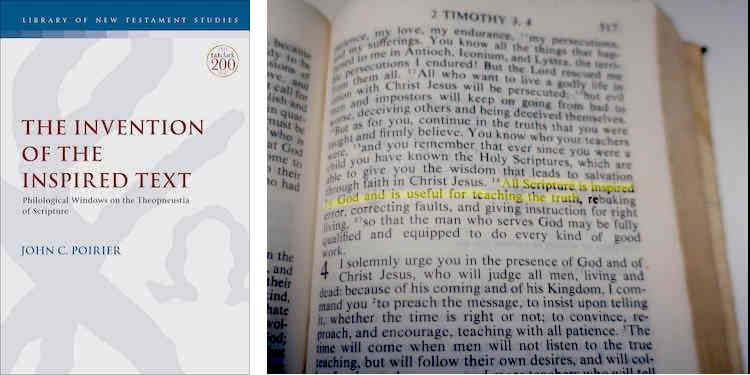
In 2022 John Poirier published his examination of these questions: The Invention of the Inspired text. Philological Windows on the Theopneustia of Scripture.
As should be obvious from the title, it is an academic book; quite a difficult read for a non-academic like me, with lots of Greek and long words. But very important and well worth the effort (for me at least). You may not want to read such an academic book, but I believe it is important we all know what it says.
Let’s start with the big words
I don’t usually get into big academic terms, but here we have to.
Philological refers to the study of language. It includes how words are used in their context, as opposed to etymological, which is the original meaning or derivation of words.
It is obvious that words can change their meaning over time (e.g. the word “gay’ is used very different in 2026 than it was in 1946). So the arguments over “God-breathed” often become arguments over the original meaning (the traditional view) vs the contemporary meaning in the first century (Poirier’s view). Most linguists these days prefer Poirier’s approach because word usage changes over time.
Theopneustia is simply the English version of the noun form of the Greek “θεόπνευστος”, from theos = God, and pneuma = spirit or breath. So it means “God-breathed” but doesn’t specify how we should interpret that.
This is the only place this word is used in the Bible. But it appears in several places in Jewish, Christian and Greco-Roman literature of the first few centuries CE.
Philology of Theopneustos
Poirier discusses in detail all the usages of theopneustos he could find in ancient literature (see note 2). His analysis indicates that, up until Origen in the 3rd century CE, “theopneustos” was used to mean “life-giving”. It is only after Origen, he says, that it started to be given the meaning “breathed out” or “inspiried”.
My knowledge of ancient Greek is rudimentary to say the least (I passed an exam in it more than 50 years ago, but remember very little now). So I’m not competent to pass judgment on his arguments and philology.
So the best I can say is that his study is comprehensive, finding more usages than Warfield did, and seems to me to be compelling.
Poirier’s conclusion
Poirier considers how 2 Timothy 3:16 should be translated in its context, and examines other New Testament passages that may be used to suggest that the scriptures are breathed out by God (2 Peter 1:19-21, John 10:35).
He concludes: “The New Testament nowhere claims to be inspired. At most it claims that the (formally) prophetic parts are inspired.” He says the early believers sought authority more in the apostles’ witness than in their writings.
2 Timothy 3:16 should be translated as: “All Scripture is life-giving and is useful for teaching, rebuking, correcting and training in righteousness….”
Critiques of Poirier
Conservative evangelical scholars have generally not been impressed with Poirier’s conclusions. They say his analysis of the ancient writings is incorrect or incomplete. Some admit that he has made a reasonable case that theopneustos could have either meaning (inspired or life-giving), but has not proved that life-giving is the only correct reading.
It seems to me that their reticence to accept his analysis is at least partly based on what it would do to established evangelical theology. (Of course it could equally be argued that Poirier has a theological bias too, as I suppose it could be said of me also.)
But even if we accept their critique, it surely remains true that evangelical theology has built a doctrinal edifice on a very weak and uncertain foundation.
Gospel, inspiration and truth
In his final chapter, Poirier considers how his philological conclusions might be received by the church. He recognises that they would likely cause consternation. After all, if the scriptures are not “inspired”, how can we be sure they are true?
This equation of inspiration and accuracy was championed by Augustine (4th century). But Origen, who was (Poirier claims) the originator of the translation of 2 Timothy 3:16 as “inspired” meaning “breathed out by God”, didn’t actually argue that inspiration implied historical accuracy. Instead, Origen believed, the scriptures did contain factual errors and inconsistencies, but had a deeper spiritual meaning not affected by these anomalies.
So, Poirier argues (following the first christians), that the truth of the gospel doesn’t depend on either inspiration or the “thoroughgoing” truth and accuracy of the scriptures, but on the honesty and human truthfulness of the apostolic witnesses.
Where does this leave us?
I feel Poirier has shown that 2 Timothy 3:16 gives at best doubtful support for the view that scripture is “inspired” in the sense of being “breathed out” by God. Thus it offers even less support to the identification of scripture as the “Word of God”.
This isn’t anything to be worried about.
We can still believe ….
We can still believe the Bible is “inspired” in the senses that (i) the Holy Spirit was active in the lives of those who wrote and compiled the scriptures, and (ii) the Holy Spirit breathes life into them and through them into us as we read.
We can still believe the gospels, not because the Bible is inerrant or God’s Word, but because the historians tell us they are good historical documents and because we can trust that the apostles gave true testimony about Jesus.
But we no longer need to believe …
We no longer have to try to defend every last little anomaly – we can find better things to do!
We no longer have to believe that Genesis 1-11 is history – God can use folk tale or legend to reveal truth, just as he can use parable or poetry.
And we don’t have to believe the blasphemous idea that a God of love could order bloody murder of children, grandfathers and pregnant women during the formative years of the people of Israel. Those stories come from an early time in the slow process of taking the Israelites from paganism to the Sermon on the Mount.
We can see the Bible ….
Some christians will find it hard to accept that our scriptures aren’t perfect (as we see perfection) because they still see them as God’s book. But this is God’s world and it’s not perfect (as we see perfection) and never was, because before there was human sin there was (animal) death. And we are part of Jesus’ body, the church, and it isn’t perfect either.
Shocking as it may seem, CS Lewis sees all this as”the greatest revelation of God’s true nature“. I can’t be sure what he meant by this, but I think he was saying that God doesn’t impose himself on the world but works through imperfect human beings to achieve his good purposes.
Softly, softly
If all this is more or less true, these are not truths that need to be shouted from the rooftops. Acceptance of them will likely be at least generational. But where hearts and eyes are open, I believe understanding will come.
I pray that is true for you.
References
- The Invention of the Inspired text. Philological Windows on the Theopneustia of Scripture. John C Poirier, Bloomsbury.
- Anchor Yale Bible Dictionary.
- Review: The Invention of the Inspired Text by John C. Poirier. Critical review. A Response from John C. Poirier. Kyle Dillon, Allkirk Network.
- A New Look at an Old Word. Tony W Cartledge, Good Faith Media. Positive review.
- Review of The Invention of the Inspired Text. Matthew J Bekken, Journal of Biblical and Theological Studies. Critical review.
- Etymological fallacy. Wikipedia.
Note 1: I am aware that many Biblical scholars doubt that Paul wrote 2 Timothy. But authorship isn’t important to the discussion here, although if Paul didn’t write it, the passage perhaps becomes less important.
Note 2: Poirier examines the following number of examples in the first to third centuries (if I have counted correctly!):
• 6 uses of theopneustos in 5 non-christian writings pre Origen (plus 2 other works of doubtful date);
• 4 uses of the related word theopnous in writings pre-Origen;
• 5 Christian writers, including Origen, who use or refer to theopneustos many times.



The violence in the Old Testament certainly provides fertile grounds for people to attack Christianity, even though there is no evidence for a world wide flood, or the deaths of all first born Egyptians.
Because there is no evidence for these, these stories should be treated as allegorical and written for the times, but even some Christians take them literally.
Do you think mainstream churches still believe the OT stories are real and teach them as such, or is the position changing to critical thinking?
I think it varies a lot. Some really believe all the stories. Some know they have to believe the stories because of their understanding of the Bible, and don’t think any more about them. Some preachers speak as if they’re all true, for the same reasons, but may not be really convinced. And many accept them as legends or at least partial legends. I think the latter group is growing, but I think, in the face of a more sceptical world, others are retreating back into a belief they previously doubted, because they feel that is a theologically safe space.
In a previous church I was in, just a few years ago, a minister with a science degree and an acceptance of evolution, gave a sermon about the Genesis creation story as if it was all true and quite specifically said he wasn’t going to address the science vs Genesis issues. I think in the conservative environment he was in, that was his safe compromise.