I heard two Old Testament sermons yesterday, and they made me think.
Something has to change!
Let me tell you the story.
Sermon 1: prayer and the Amalekites
A preacher I appreciate and respect wanted to encourage his large and mostly young congregation to be diligent in prayer. So far, so good.
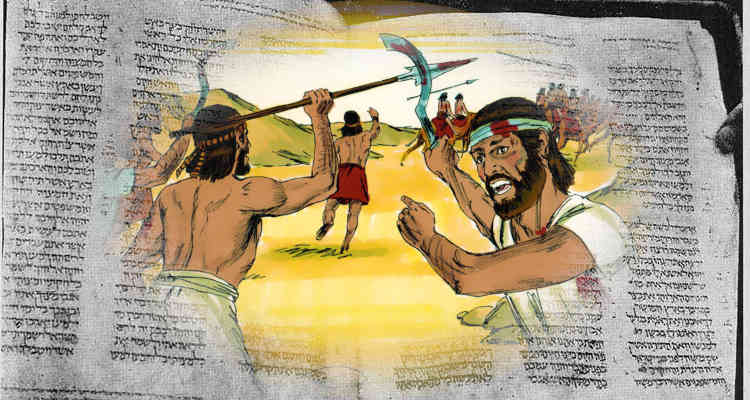
He chose as his passage Exodus 17:8-15, a well-known story where Joshua fights the Amalekites, and is successful while ever Moses lifts up the staff of God. But when he tires and his hands droop, the Amalekites prevail. So Aaron and Hur hold his hands up so Joshua can win the battle.
The lesson is clear. We can only win life’s battles if we persist in prayer – though prayer isn’t actually mentioned in the passage, it is only assumed.
So far, so good?
But the passage contains some less positive elements. While our battles are generally not literal fighting, Joshua’s was. He was conquering the Amalekites “with the sword“, which means bloody fighting and killing.
And at the end, God tells Joshua he will “blot out the name of Amalek from under heaven”, which sounds a lot like genocide. Some say it doesn’t mean killing the whole tribe but only ensuring the name Amalek isn’t remembered. But later (1 Samuel 15:3) God is said to have commanded Saul to totally wipe out the Amalekites, so it certainly seems like genocide.
No-one really knows for sure where the Amalekites lived (though perhaps it was southest of Canaan) or who they were, so we can’t really know if they have indeed been blotted out. But the commands are there.
What was he thinking?
I have been wondering how this genuinely caring preacher feels about this aspect of the passage.
- Does he believe a loving God justifiably supported killing and perhaps genocide? I doubt he would feel comfortable about saying this.
- Does he think the story is exaggerated, or even legendary? Perhaps, but he didn’t say so.
- Does he simply not know what to think, so he avoids the hard question, which wouldn’t help his message? That would be my guess.
But I believe (as we shall see) his avoiding the question probably won’t end well.
Sermon 2: the Amalekites must go!
These thoughts reminded me of a talk I heard several years ago, about the exodus and the book of Deuteronomy. The speaker, more conservative than the first preacher, arrived at the same event.
But his take was different.
He definitely felt God justifiably ordered the elimination of the Amalekites, and later other Canaanites. Those tribes had obnoxious religious and ethical practices, he said, which would corrupt God’s people. They had to be eliminated.
It was like “excising a cancer” he said, and therefore eminently reasonable.
So apparently he was quite comfortable with the idea that the creator of the universe, revealed in Jesus (and in the Old Testament) as a loving God, and one who commanded his people not to murder and to limit revenge to “an eye for an eye”, was quite justified in ordering the terror and mayhem of the bloody execution of pregnant women, children, grandfathers and parents with their babies, among others.
What was he thinking?
Being a conservative evangelical, this speaker had little choice. In his mind, the Bible is God’s word, it speaks truth, so this event as described must have happened and God must have had a good reason for it.
But there are other options. Perhaps the Bible is “God’s word” (however we may define that) but it may contain legend or exaggerated history as well as accurate history. Is that too hard to accept?
To those who baulk at this idea, I’d point to Jesus’ parable of the Rich man and Lazarus (Luke 16:19-31) and ask if it is historical. Few would say so. Who could believe that there is open conversation between those in heaven and those in hell (for those who believe in a literal hell)? It is a parable, not a history.
So if Jesus could use parable, which isn’t historical, is there any reason why God couldn’t use legend?
A not so difficult choice?
Really, we have a choice. We can believe that the Bible’s Old Testament narratives are always literally and historically true and God’s character is highly problematic. Or we can believe that God is in reality a loving, non-violent God and parts of the Old Testament are legendary or exaggerated.
The first view seems blasphemous to me. And the second has the support of two facts:
- On at least one occasion where Jesus quoted a violent Old Testament passage (Luke 4:18-19, quoting Isaiah 58 & 61), he omitted the violent part (“the day of vengeance of our God”). On three occasions (Romans 3:10-18, 12:19-21, 15:9-10) Paul did the same. It’s not the only time Jesus corrects or modifies an Old Testament teaching (see Matthew 5:22, 32, 39). It seems Jesus and Paul were unwilling to ascribe some of the Old Testament violence to God.
- The archaeological record indicates that the arrival of the Israelites in Canaan was not generally as described by Exodus, Deuteronomy and Joshua 1-12. The evidence suggests these narratives were not reliable history.
Sermon 3: understanding the Old Testament
The second sermon I heard yesterday was from a speaker trained in a conservative theological college, but who had been willing to change his understanding to follow the evidence.
He was able to see the Genesis creation story as “mythic …. not a precise chronological log book“. A hospitable God creates, without violence, places for people and creatures to live.
It wasn’t hard for me to extrapolate to thinking this speaker wouldn’t have seen God as meting out the terrible violence of Exodus and Joshua as speaker 2 did.
He too didn’t think it necessary to think all Old Testament narratives must be totally historical.
And he was willing to briefly explain why he concluded this way, unlike speaker 1.
Why is this important to me?
Two reasons.
1. Ideas become violent reality
What we believe can affect how we behave.
Israel’s Prime Minister, Benjamin Netanyahu, was reported to have used the Amalekite story as part of his justification for the murder of so many Palestinians.
Parts of the Christian church in the US seem to have forgotten the teachings of Jesus in favour of Old Testament style violence and xenophobia at home and in support of Israel.
Belief that God commanded terrible violence seems to make it easier to justify the same today.
2. Losing credibility, losing faith
I know of many people who have struggled with some of the more violent and less loving parts of the Old Testament, which led to them giving up their Christian faith entirely. If God was really like that, they cannot believe.
If only they had been taught that God may not be like that, that there are several different views of how we should understand these passages. It is possible to believe in a loving God and in Jesus, if we understand the Old Testament rightly.
Something has to change in how we teach the Old Testament!
Graphic: Free Bible Images and Rachel-Esther via Compfightcc, combined by unkleE.




Eric, good discussion and very timely for me as I’ve been rather deeply impacted by this. I’m aware that over the past 100 years or so, and especially over the past several decades, fundamentalist Christians have been making the claim that EVERYTHING that is narrated as pros in the Bible must be considered to be in the genre of literal history. I see this as a cultural expectation and if you don’t hold this view you might be construed as someone who is attacking the Bible, and maybe in the same camp as an atheist. This biblical inerrancy expectation has been placed at the top of the list of the statements of faith for many churches here in the USA, including all churches I have attended. When I have tried to speak out against this with church leaders — that many of the OT stories are not literal — it is met with a lot of very defensive criticism. I wholeheartedly agree that something needs to change.
Hi Dean, I’m glad it resonated with you.
It is a difficult issue for many because they confuse genre with truth. While they can accept that a parable may not have actually happened, they seem unable to think the same about OT stories. Even Job, which doesn’t have asny historical context, can only be truthful and God’s word (in their minds) if it is historical.
Inerrancy is another issue again, because it doesn’t guarantee much as inerrantists disagree about many things despite that belief.
I think things are changing slowly, but there are always early and late adopters as well as those refusing to change. But they say science changes “one funeral at a time”, and I belief change will come to the church generationally,