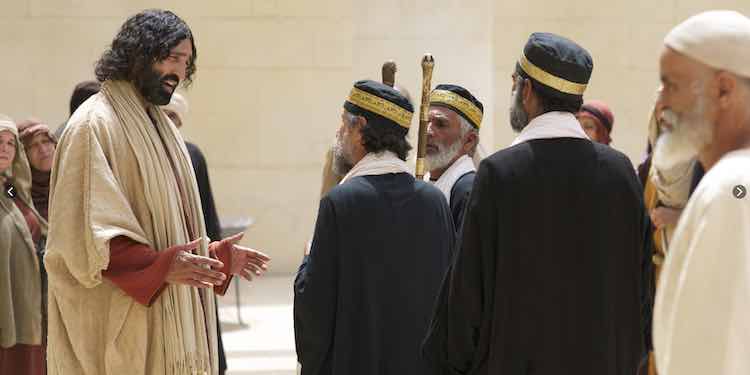
Jesus was one of the most famous and influential people in world history.
But so much disagreement about who he was. For the stakes are high.
Let’s look at the five most popular pictures of Jesus.
1. The evangelical Christian Jesus
This is the picture most readers of this blog would be most familiar with, even if they don’t believe it.
On this view, Jesus is the God of the universe in human form. He knows everything. He is powerful to do miracles. He can walk on water and feed thousands of people with a few loaves and fish.
But the most important thing about his mission is that he came to die to save believers from their sins. And then rise again to prove he had defeated death.
But he’s also the cosmic Jesus in the book of Revelation. Fighting battles, defeating the devil in the form of the beast, on his throne and receiving worship. And answering our prayers.
It’s a glorious picture and billions of people have believed it. I used to believe it too – and still believe much of it is true.
Trouble is ….
…. this isn’t a complete picture. It ignores or plays down some important parts of the story his biographers have left us with.
It omits almost entirely what historians say was his main message and purpose – the kingdom of God on earth. It tends to give lesser emphasis to his teachings, and explains away some of his teachings that don’t fit evangelical theology.
Jesus sometimes teaches that eternal life depends on us loving our neighbours (see Matthew 25:31-46, Luke 10:25-37), which of course seems contrary to Paul’s teaching on salvation (e.g. Ephesians 2:8-10). I’ve seen an evangelical preacher say Jesus told the Good Samaritan parable to show us that we couldn’t live up to God’s demands rather than what it actually says, that we must love our neighbours!
Sometimes he doesn’t seem like a first century Jew at all.
2. The mythical Jesus
There are those who argue that Jesus didn’t exist. Most commonly, they say that the ideas of Jesus as a heavenly being arose via visionary experiences such as Paul’s vision of Jesus on the Damascus road.
The gospels were written, they say, several generations after Jesus by people who weren’t eyewitnesses (obviously). They invented the stories found in the gospels. Paul’s letters hardly mention any historical details about Jesus because Paul didn’t believe he was a human on earth. Many of the stories about him are based on myths of dying and rising gods or other ancient “superhero” figures.
So there is no early historical evidence of Jesus because he never existed.
Trouble is ….
…. most ancient historians, whether religious or non-believing, say these speculations are all wrong. Paul does mention a few details of an earthly Jesus and says he has met his brother. Ancient myths provide very few parallels to Jesus.
The gospels are based on sources close to the event, even if these sources are sometimes in error (as most historical sources are in places). In fact there are numerous sources, including a few unfriendly ones – much more than for most ancient figures. These show that inventing the entire Jesus story would be impossible.
The problem with most proponents of the mythical Jersus idea is that they have limited historical expertise and are thus basing their judgments on inadequate understandings of ancient evidence.
Whatever we may believe about Jesus, he was a real person and we know some useful things (at least) about his life.
3. The peace and love Jesus
To many people, Jesus is a great ethical teacher who showed how we can and should love others, even our enemies.
He was a good, peaceful man who was ground up and spat out by powerful people who had no compunction about killing him.
Put him up there with the Buddha, Nelson Mandela and Baha’u’llah if you like, but son of God he wasn’t, and his death wasn’t a triumph but a tragedy.
Trouble is ….
….the historians say this isn’t a true understanding of Jesus either, it ignores Jesus ‘ setting in first century Judaism and ignores the apocalyptic edge to his teachings..
Good Jews were expecting a Messiah who would throw off the yoke of Rome and restore Israel as God’s chosen people. Some were waiting patiently, some were prepared to fight for it.
Jesus confronted these expectations. If he was the Messiah (he tended to be coy about that), he wasn’t going to act by force. He predicted God would set up his kingdom on earth, and he predicted this event would be cataclysmic, though he refused to be violent himself.
So Jesus saw himself as more than an ethical teacher.
4. The end-times prophet Jesus
This view places Jesus firmly in first century Judiasm. He may have seen himself as the Messiah. He was certainly seen by many of his fellow Jews as a prophet in the tradition of the Old Testament prophets, a teacher and a healer.
He used the Jewish scriptures to explain his actions and claimed to speak and act on behalf of God. He predicted his imminent execution and believed it would lead to Israel’s redemption.
But according to this view, he was mistaken. And ultimately he failed. God’s kingdom didn’t materialise after his death. Instead, 40 years later, the Jewish temple was destroyed and Roman power seemed as strong as ever.
False Messiah’s came and went. But somehow Jesus’ followers came to believe had had been resurrected and vindicated, and so the Christian faith was born out oif the disaster of their teacher.
Trouble is?
This view is based on good historical analysis. It recognises Jesus’ context and the genuine faith of his first followers.
It requires no supernatural explanations, which is generally considered good historical method, though that may be an unwise and self-fulfilling assumption when dealing with a person like Jesus.
But arguably it doesn’t explain Jesus’ apparent miracles, his resurrection and the disciples’ dramatic change in belief and behaviour. It struggles to explain why Jesus didn’t fade into the pages of history like all the other would-be Messiahs.
In the end, it is a lowest common denominator judgment on top of good historical analysis. Nevertheless, it is seen as a believable option by many scholars.
5. Jewish king Jesus
This view isn’t so far from the previous one. Yes, Jesus was seen as a prophet, teacher and healer – but because he was those things, and more.
His main message was indeed the kingdom of God on earth, but he saw this as a spiritual kingdom, based on people living as in the Sermon on the Mount, and. recognising him as God’s king. And he was opposed to violence.
He was an ethical teacher (as in the ethical teacher Jesus) but his ethics were tied to the kingdom of God. He saw his death as redemptive in ways that went beyond beliefs about the evangelical Jesus and the end-times prophet Jesus.
He didn’t teach a simple “believe and you’ll be saved” message like evangelical Jesus. He asked people to follow him, that is follow his teachings and give him our allegiance. He didn’t spell everything out (I think deliberately), but it seems he asked us to believe in him as a way into trusting him, following his teachings in the Sermon on the Mount – loving neighbour and loving God whole-heartedly.
Trouble is?
I believe this belief is most in keeping with the gospels. It takes Jesus’ Jewishness seriously. It accepts the supernatural, as the gospels do. It takes Jesus at his word rather than trust theological abstraction from half a world and two millennia away.
But it requires us to trust that the gospels writers were honest and trust that Jesus told the truth. It requires us to believe things that go against the naturalism of our day.
Some find that difficult, some find it easy.
Resolving the dilemma
There are right understandings in all five views, I believe, but only the last two options fit the historical facts.
- Mythical Jesus ignores the evidence and invents explanations that don’t hang together. Its only virtue is that it recognises that history cannot give us certainties, only probabilities.
- Jesus was an ethical teacher who showed God’s love. But Peace and love Jesus is just too simple, too modern, too little conformed to the historical reality, too much based on what we might instinctively like.
- I grew up with Evangelical Jesus and see a lot of truth there – the importance of making choices about Jesus and the universal need for forgiveness. But I see a lot of historical facts that it misses and which Jewish king Jesus addresses.
So it is a choice (I believe) between end-times prophet Jesus and Jewish king Jesus. Both try to include the historical facts. One view dismisses the supernatural, and the beliefs of the gospel writers, while the other view accepts them.
One says ultimately that Jesus was mistaken, a failure, a good man who led people down a dead end. The other says he was a winner, he is alive today and offers hope to those who choose to follow him.
Both are historical realities, but only one is contemporarily relevant.
Personally ….
For me, the puzzle is resolved even though I don’t have all the answers.
Looking around at the universe and the human race makes me think there must be a God. I find Jesus plausibly represents that God better than anyone else. And Jewish king Jesus conforms best to the gospels evidence.
What do you think?
Graphic: Free Bible Images