I seem to be thinking a lot about politics these days. It’s not an accident. Politics has always been about ethics – either ethical politicians caring for the people of their nation, or unethical politicians caring for something else.
And my faith also is linked to ethics – Jesus famously told us that love of God must be accompanied by love of neighbour.
So buckle up for another sad story of people not loving their neighbour and how followers of Jesus can show a better way..
Last weekend was ANZAC day, and a few things happened.
Anzac Day in Australia
Anzac Day (April 25) is probably the “holiest” day in the Australian calendar – more than Easter or Christmas for many Aussies. It commemorates a futile and foolish attempt to land a force in Turkey during World War 1, in which Australian and New Zealand forces supporting the British action acquitted themselves bravely despite eventually being unsuccessful. (It is kind of typically Aussie to commemorate a failed but brave action.)
Anzac Day typically begins with dawn services in many locations, from major cities right down to small settlements. The dawn service has a fairly fixed format of a patriotic hymn, some prayers and readings, some with responses, silence for remembrance and the last post played on the bugle.
Later in the day, there will often be marches of veterans or their surviving relatives, often attracting large crowds. Most shops remain closed.
As veterans of major wars aged, Anzac Day’s importance seemed to be waning, but in recent years younger Aussies have taken a growing interest. I personally have mixed feelings about Anzac Day, having served two years in the Australian Army (not by choice) and come to see most wars as unnecessary results of politicians’ hubris, and seeing serving personnel as victims as well as heroes.
Welcome to country
Australia’s Aboriginal and Torres Strait Islander people have been here for something like 60 millennia and are seen as being the oldest living culture in the world.
From their quite reasonable perspective, the British invaded Australia in 1788 and sometimes brutally suppressed the First Nations people, who suffer from social disadvantage leading to adverse social and health outcomes.
Well-meaning governments have attempted to redress some of these wrongs through a series of legal and cultural recognitions over the past half century.
One practice has been to have short “Welcome to Country” or “Acknowledgment of Country” ceremonies at the start of many public events. These ceremonies reflect the First Nations people’s custom of recognising different tribal or country boundaries, and not stepping onto a neighbouring tribe’s country until welcomed, as a sign of respect and peaceful intention.
Current Welcome/Acknowledgment ceremonies no longer fit that context, but are done as a sign of respect to First Nations people and a recognition that their land was taken off them by white colonists. The church I attend has a short statement of acknowledgment that is repeated by all present every week. Many events I attend also have acknowledgment.
Anzac Day Acknowledgment
First Nations soldiers have served in Australia’s armed forces and some have died for our country. (I was helped in learning to fire a rifle for the first time by an Aboriginal soldier – Corporal Bostock – I still remember as gentle and helpful – unlike many NCOs leading recruit training.) So Acknowledgment or Welcome to Country, spoken by a prominent First Nations leader, has become part of the standard Anzac Day liturgy.
But this year, in several locations, a small number of participants booed during this part of the service. Apparently some far right online discussion encouraged this action.
The police moved some of the “protesters” on, and the rest of the crowds apparently applauded the acknowledgment to show their support for the First Nations leader who the protesters were attempting to humiliate.
Uncle Ray Minniecon
At the large Sydney Dawn Service (which I didn’t attend), the Acknowledgment of Country was spoken by Pastor Uncle Ray Minniecon. Uncle Ray continued speaking despite the booing, and was warmly applauded as he finished.
This event was reported in all the news services, and Uncle Ray, in his own words, became a public figure.
Uncle Ray has become a personal friend over the past two years as we attend the same church. I know him to be thoughtful, sensitive and generous. Like many who have commented on this matter, I was ashamed of the way he (and other First Nations people) were treated and have been treated.
This, sadly, isn’t an isolated incident of racism. As he said: “it was just another Saturday in Sydney.”
Reactions
Many First Nations people felt rejected and misunderstood (again). And variously sad, angry or resigned. They feel they continue to be treated as colonised and unequal. Somehow they should conform to white Australians’ expectations and not be recognised and accepted on their own terms. Without even a treaty to clarify their situation.
There has been strong criticism of the booing in the media and politics. I think the strongest feeling was that such protest shouldn’t interrupt a solemn Anzac day ceremony. One letter writer to the Sydney Morning Herald said that as an atheist he didn’t agree with the prayers, but it was an occasion for him to put that aside out of respect.
But there was also considerable support for Uncle Ray and the other Aboriginal leaders targetted. But the booing was deeply hurtful.
Opposition to Welcome to Country
But of course not everyone feels positive about these ceremonies. Numerous websites have expressed strong negative views (see e.g. The Noticer, Sky News, News.com and League of Rights). Not all would support disrupting a Dawn Service, but some apparently do.
Being welcomed to our own country.
This seems to be the most common objection. Welcome to Country says “you do not belong here”, as if “the country does not quite belong to itself.” (Sky) So, it is argued, it means non indigenous have secondary status (ALOR), they (we) are “perpetual guests” (Sky).
This is an unfortunate misunderstanding and exaggeration. It is clear that no-one is being welcomed to Australia. Before white colonisation, there were hundreds of Aboriginal “countries”, and it is to these that people are being welcomed – e.g. Gadigal land or Bunurong Country.
It is similar to when we meet a visitor from out of town, we say “Welcome to Sydney”. There is no suggestion they aren’t entitled to be here in Sydney, nor that we have exclusive ownership of the city, we’re just welcoming them.
The Aboriginal welcome is exactly that – an offer of friendship and togetherness, and the hope of fellow feeling and recognition.
It is divisive
This follows from the previous objection. Welcome to country is accused of being “a divisive practice that undermines national cohesion” (ALOR). It separates rather than unites.
Clearly the practice has become divisive, but it doesn’t need to be. Anyone who has read the definitive First Nations statement, the Uluru Statement from the Heart, knows that it is a generous document in which First Nations people are seeking an equal partnership with non-indigneous people. Aboriginal people have suffered a lot from white colonisation, but in Acknowledgment of Country they are offering a friendly welcome. If we whites accepted that welcome, there would be unity, not division.
It isn’t genuine
This objection takes several forms.
- Some say it is only a recent construct, and not traditional. (But anthropologists say it is indeed traditional, for when tribes wanted to enter another country. It is just being used in a different context now.)
- Some say it is token, insincere, performative. (That’s probably sometimes true. But it is just as true for many other things, like prayers to open Parliament or speeches at funerals, but that doesn’t mean they always are.)
- Some claim it is a lucrative business for those indigenous people performing this ceremony. (I’m not aware of anyone being paid for this, but likely it is true in some cases. But the whole of Anzac Day costs money – army and police presence, logistics, clean-up afterwards, etc.)
There is a hidden agenda
This may be the issue that provide fuel for the others. Some believe there is a hidden agenda to promote First Nations interests.
It is claimed that welcome to country says “Australia does not really belong to Australians as a whole. ….. Everyone else is effectively on a long lease, renewable at the pleasure of the ‘Traditional Owners'” (Sky). It has been “weaponised to advance agendas like Indigenous sovereignty, treaty demands, and reparations.” (ALOR)
Whenever the government has tried to recognise First Nations people and reverse some of the harm done, these sorts of claims are made. Yet no-one has ever lost land in this way. No one has ever been sent overseas because of Aboriginal recognition.
But First Nations people would like to have a treaty with the government, as has happened in New Zealand, United States and Canada. There was an invasion and fighting; a treaty to tidy things up seems reasonable. I haven’t seen any good reason why this shouldn’t occur and any explanation of supposed harm that would result from it. But anything which seems to give First Nations people extra recognition seems to be opposed by some.
Taking helpful action
It is argued we would be better “moving beyond divisive symbolism and focusing on practical measures to address Indigenous disadvantage” (ALOR). “A serious country would do something better.” (Sky)
This may be true. But why not both?
Some say a lot of money has already been spent on these matters, with little benefit. This seems to be true. Governments haven’t always consulted wisely. We can do better.
It is spiritually inappropriate
Some Christians oppose Welcome to Country, especially if accompanied by a smoking ceremony, because they believe it is syncretistic and often carries non-Christian overtones.
I believe these views are mistaken. I understand they are held sincerely but they are nowhere near universal among Christians.
It has been overdone
There is a strong feeling among critics, and perhaps slowly gaining ground in the wider white population, that Welcome and Acknowledgment ceremonies have been overdone and are no longer meaningful or helpful.
Uncle Ray suggests “We don’t have any significant way of acknowledging that [land rights] – no treaty, for example. So this is the closest we can get to our history and rights being acknowledged.”
Perhaps if white Aussies were more open to First Nations feelings, history and rights, Welcome to Country might not be “overdone”.
Assessing the reasons
It is hard for me to take some of the arguments seriously when they include such insulting language: “this absurd theatre” is a “lucrative sham”, an “ethnonationalist con”, “a demand for submission dressed up as politeness” (Sky).
Therefore it seems to me that the opposition comes down to three reasons:
- Some people want to preserve their wealth and privilege and don’t want to risk losing any of it. Recognising the injustice of past treatment of First Nations people would be a threat to them, or to their self image as Australians.
- They use the various media to create false ideas, anger and fear in otherwise indifferent people, to lead them into opposing these ceremonies and any move to give greater recognition to First Nations people. Creating fear and anger is a recognised tactic of some media and some powerful people.
- Racism is an easy feeling to fall into, especially white people denigrating black people, so this natural tendency provides fertile ground for opposition.
Why does a Christian like me care?
It is a fact that white people colonised Australia with scant regard for the original occupants, just half a dozen generations ago. First Nations people have lost land, culture and often their lives. They have had their rightful wages stolen and their children taken away. They live today, on average with significant social and health disadvantage.
We cannot undo the harm. But we can understand that they mourn what they have lost. And continue to feel hurt by the treatment they have received.
Some people think that First Nations people should just put it aside. (Ironically Anzac Day is a day of remembering the past, not putting it aside.)
But as a Christian I am required to “weep with those who weep” (Romans 12:15); to seek justice for the disadvantaged (Matthew 23:23); to love my neighbour (Mark 12:31); and to oppose racism because God created all people in his image (Genesis 1:27). To have compassion (Colossians 3:12).
The First Nations people I know have every right to resent white colonisation, but instead they generously ask that we non-indigneous people simply walk with them on a journey to remove racism, recognise history and work for equality.
How could I refuse?
And so I have taken the trouble to listen to First Nation’s voices, build relationships where I can, offer support when needed (e.g. in the 2023 failed referendum to give them a Voice to parliament), learn the truth of black-white relations in Australia, and respond to that information. And pray for them and with them, for things to get better.
I think that’s what Jesus would do.
The future?
A better critical response
It is obvious that on this matter, as on many others, Australians have a wide range of opinions. How might critics of Welcome to Country better repond?
- It would be helpful if the extreme and sometimes untruthful, hurtful and racist criticisms ceased, and opposition be expressed truthfully and calmly. And with more sensitivity to First Nations people. Opinions can be expressed in less-hurtful ways – if people want to be kind. I fear many do not.
- It would further be helpful if all critics spent time with First Nations people and took time to read about the history of black-white relations in this country (if they haven’t already).
- There are many public events where things are said that we may not agree with. (Many Christians would find some of the content of Anzac Day services problematic, as would atheists.) It isn’t difficult to stay silent and not engage with the things that trouble us.
The future of Welcome to Country
I think it likely that Welcome or Acknowledgment will be offered less frequently in the future, whether that is a good idea or not. But hopefully it will be better understood and received by all, and any diminution accompanied by progress in other areas.
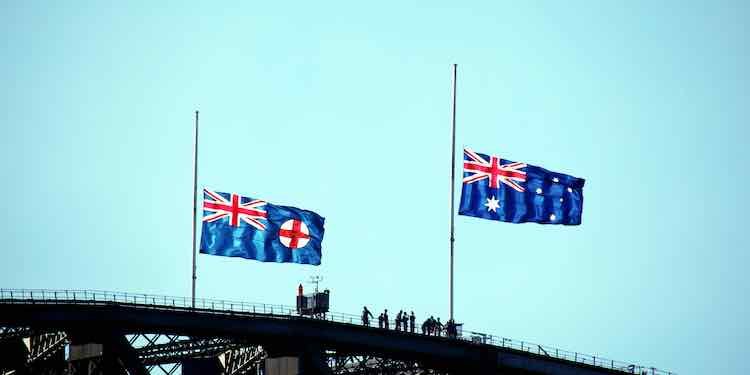
Photo. The Australian (right) ands NSW flags flying at half mast above the Sydney Harbour Bridge (dp singh Bhullar). Flying flags at half mast is done to mourn a death or on a day of national commemoration, such as on Anzac Day. I have shown this photo because my post is about Anzac day, and mourns racism in Australia.



I think Welcome can be over used, but on solemn occasions like ANZAC day it is appropropriate and does no harm to treat it with respect.
I like your analysis, you covered the salient points well
Thanks.
It looks like extremists were responsible for the Anzac Day disruptions, they can hardly represent the majority.
https://www.abc.net.au/news/2026-06-04/anzac-day-welcome-to-country-booing-neo-nazis-found-guilty/106757584
Thanks for that link. Yes, it shows that was the case in Melbourne. Not sure if it was the same in Sydney and other places, but may have been. I see these events as extreme forms of views that I disagree with but are becoming more common, seen, for example, in the rise of populkarity of One Nation, the defeat of the Voice legislation, and ongoing racism reported by First Nations people. But hopefully these extremists don’t lead other people into offensive behaviour.