Today is Good Friday, in the middle of Easter week from Palm Sunday to Easter Sunday.
It has also been a holy festival for Jews – beginning at sundown on Wednesday with Pesach (Passover) and finishing a week later.
Christians have been celebrating Good Friday for more than 1,800 years. According to the Jewish scriptures, Passover has been celebrated for well over 3,000 years, although historians think it was probably first observed about 2,500 years ago.
Either way, that’s a long-standing tradition. But traditions can be changed.
The Seder
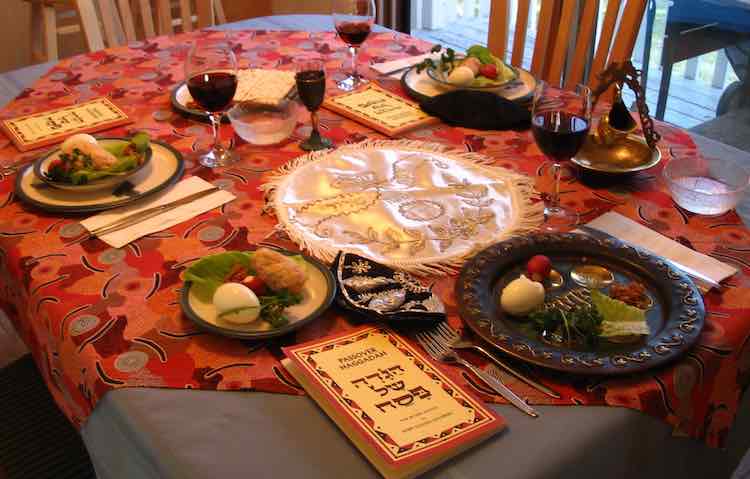
Passover begins just after sundown with a Seder meal, a ritual feast where the story is told of the liberation of the Israelites from slavery in ancient Egypt, taken from the Book of Exodus (Shemot) in the Torah.
It is a celebration of liberation.
Everything in the meal has a meaning:
- Matzah is the bread of poverty and affliction, but also the bread of freedom.
- Maror are bitter herbs which symbolize the bitterness of slavery.
- Chazeret are other bitter vegetables.
- Charoset is a sweet paste representing the mortar which the Jewish slaves used to cement bricks.
- Zeroa is a roasted lamb or goat bone, symbolizing the sacrificial lamb.
- Beitzah is a roast egg symbolizing the festival sacrifice.
- Four cups of wine remember four promises of God’s deliverance.
- Afikoman is a special piece of matzah eaten at the end.
Involving children by question and answer (the children ask the questions) and other activities is a major focus of the meal.
The Seder Haggadah
The Haggadah is a written guidebook to the conduct of the Seder. It outlines the story of the Exodus from Egypt, and includes prayers, psalms and thanksgiving. The Haggadah originated in about the 2nd century CE, and has existed in many different forms over the years.
Haggadah 2026
In celebrating the release from slavery in Egypt, the Passover cannot avoid the fact that the story involves the death of Egyptian first-born children (see note about the Exodus story at end).
Furthermore, the end of the Exodus story involves the wholesale slaughter of Canaanite and other tribes as the Israelites entered the Promised Land of Canaan. Some of these stories have been used to justify Israeli invasion and war crimes in Gaza, Lebanon and now Iran.
Many modern day Jews are critical of Israel’s actions in these wars, and so are very sensitive to how celebration of Passover might appear to show support for murder and destruction.
So a modern day Jewish organisation in the US, Jewish Voice for Peace, supported by Rabbis for Ceasefire, produced an updated Haggadah for use in this year’s Seder.
This Haggadah, with the title Next Year in Safety & Liberation, is a powerful statement.
It is written because “the Pharaohs of our time are carrying out a campaign of mass slaughter and destruction across Palestine, Iran, and Lebanon — claiming to do so in the name of Judaism”.
It speaks out against fascism, genocide. mass slaughter and destruction, and supports “the freedom of Palestinians and all people in a time of genocide and fascism”.
This stand is explained: “The story of Passover teaches us that our history is one of standing up to oppression …. We fight because opposing Pharaohs is a Jewish tradition. We fight because we know our freedom is intertwined with the freedom of all people”.
I find this move so encouraging and fascinating for three reasons.
1. Standing up for others
I am always encouraged when I see people standing up for the rights of others, especially those who are oppressed and victimised. It especially encouraging because most of the Palestinians, Lebanese and Iranians are Muslim, which has often been seen as opposed to the Jews.
So I am so glad that Jews in the US, Australia, Israel and elsewhere are opposing Israel’s and USA’s war and atrocities in the Middle East.
2. Like Jesus?
Caring for the poor, loving enemies and opposing oppression are very much in keeping the teachings of Jesus (and doubtless other rabbis). I can imagine Jesus saying to the Jewish Voice for Peace: “You are not far from the Kingdom of God.” (see Mark 12:32-34).
This is in direct contrast to some who identify as Christians who support the war, the violence and the killing. I’m thinking particularly of Defence Secretary Pete Hegseth who prayed at a supposedly Christian service for “overwhelming violence of action against those who deserve no mercy” – presumably believing that innocent non-combatants, including children, don’t deserve mercy!
(I hope he very soon remembers Jesus’ statement (Matthew 5:7): “Blessed are the merciful, for they will be shown mercy.”)
So these rabbis and other Jews appear to be closer to Jesus than many US Christians (and I hope that statement isn’t offensive to any Jews, for it’s meant to be a compliment).
3. Updating tradition
Old Testament scholars tell us that the Jewish Tanakh, which is more or less equivalent to the Christian Old Testament, contains many teachings that show signs of development and even disagreement over the time they were told, passed down and written down.
Laws change. Slavery laws became more humane from Exodus to Leviticus and Deuteronomy. The Passover laws, first given in Exodus, were different in Deuteronomy (presumably because conditions had changed), and the differences combined in 2 Chronicles.
The prophets update laws. Ezekiel corrects a statement in Exodus about children being punished for their parents’ sins – Ezekiel says God won’t do that. Many of the prophets downplay the importance of ritual and sacrifice (as given in the Torah), and emphasise justice.
Jesus updated the Law even more. Famously, in the Sermon on the Mount (Matthew 5-7), Jesus gave new, and stricter, interpretations of a number of Old Testament laws.
Peter Enns says: “The Bible …. exhibits …. the sacred past being changed, adapted, rethought, and rewritten by people of faith, not because they disrespected the past, but because they respected it so much they had to tie it to their present.”
This willingness to draw from the past but re-shape tradition was a feature of Biblical Judaism.
And today we see modern day Jews doing the same thing with their Haggadah. The telling of the ancient stories has been updated to apply Biblical ethics to the issues of today.
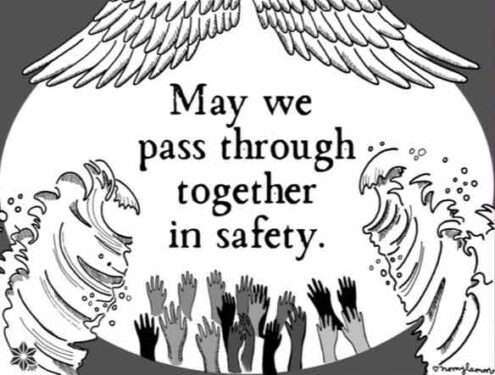
This graphic, referring to the parting of the Red Sea, which, in the story, allowed the Israelites to escape while drowning the Egyptians, shows how modern day Jews want to see non-Jews free with them.
Note: Historians doubt many aspects of the Exodus story, including the numbers of people involved, the plagues, the conquest of Canaan, and sometimes the entire story (see The Exodus – what can we learn? and The Canaanite genocide – a historical perspective). Even if this is the case (as I believe), the stories remain powerful as foundational stories or aetiological myths for Jews.
Photo of Seder table by User:RadRafe~commonswiki.